











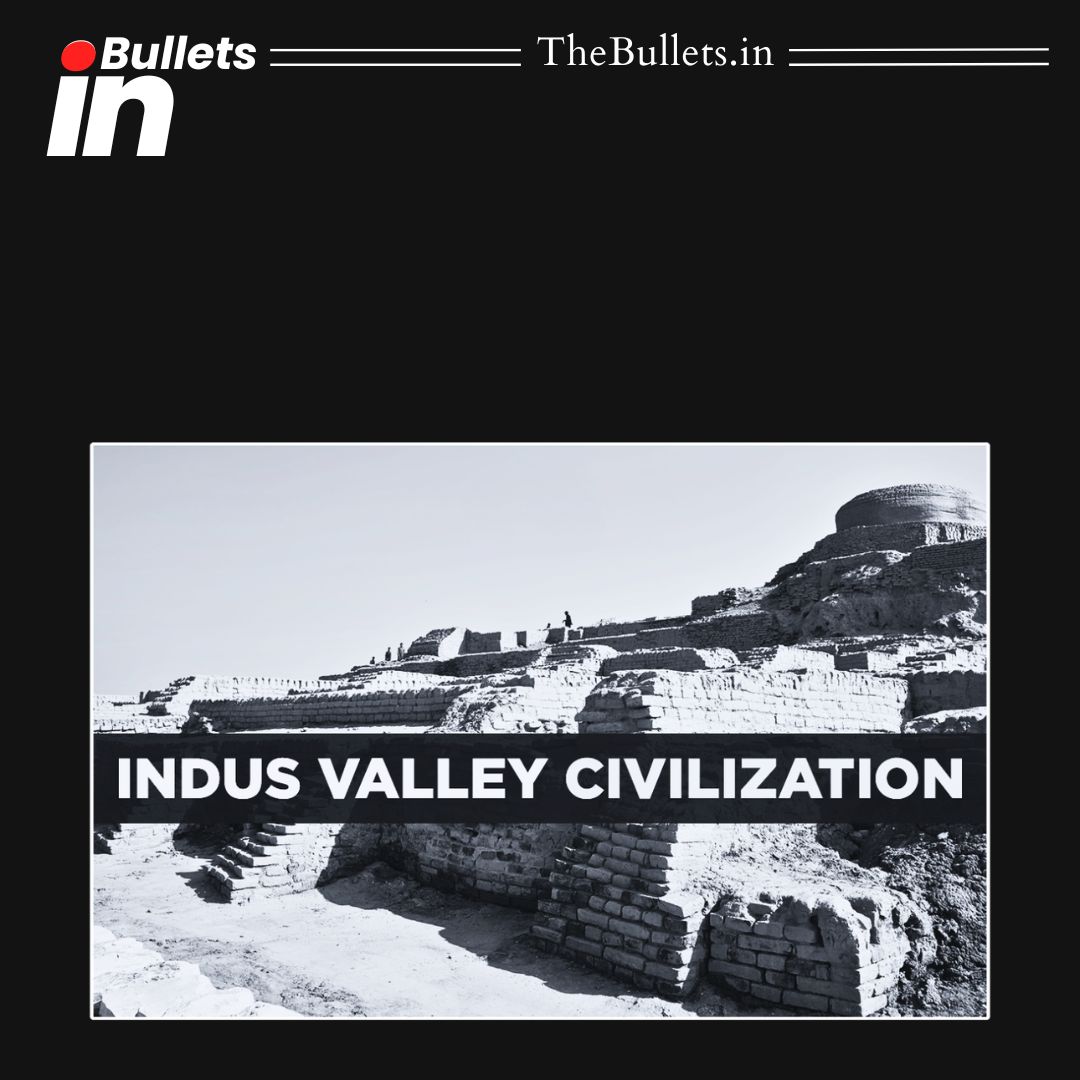


The Indus Valley Civilisation (IVC) was the earliest urban civilisation of the Indian subcontinent. Flourishing between 3300 BCE and 1300 BCE, it was known for advanced town planning, trade, drainage systems, standardised weights and measures, and a well-developed urban culture.
BulletsIn
- The Indus Valley Civilisation (IVC) flourished between 3300 BCE and 1300 BCE.
- It is also known as the Harappan Civilisation because Harappa was the first excavated site.
- The civilisation developed along the Indus River and the Ghaggar-Hakra river system.
- It is one of the world’s earliest urban civilisations, alongside Mesopotamia and Ancient Egypt.
- The civilisation is divided into Early Harappan, Mature Harappan, and Late Harappan phases.
- John Marshall officially announced the discovery of the civilisation in 1924.
- Major sites include Harappa, Mohenjo-daro, Dholavira, Lothal, Kalibangan, and Rakhigarhi.
- Cities followed a grid-pattern town planning with wide roads and well-planned streets.
- The civilisation is famous for its advanced underground drainage system.
- Important structures include the Great Bath, Granary, Dockyard at Lothal, and water reservoirs at Dholavira.
- Agriculture was the primary occupation, with wheat, barley, peas and rice cultivated in some regions.
- Trade flourished with Mesopotamia, Central Asia and internal Harappan cities.
- Standardised weights, measures and seals were widely used for trade and administration.



What do you think?
It is nice to know your opinion. Leave a comment.