











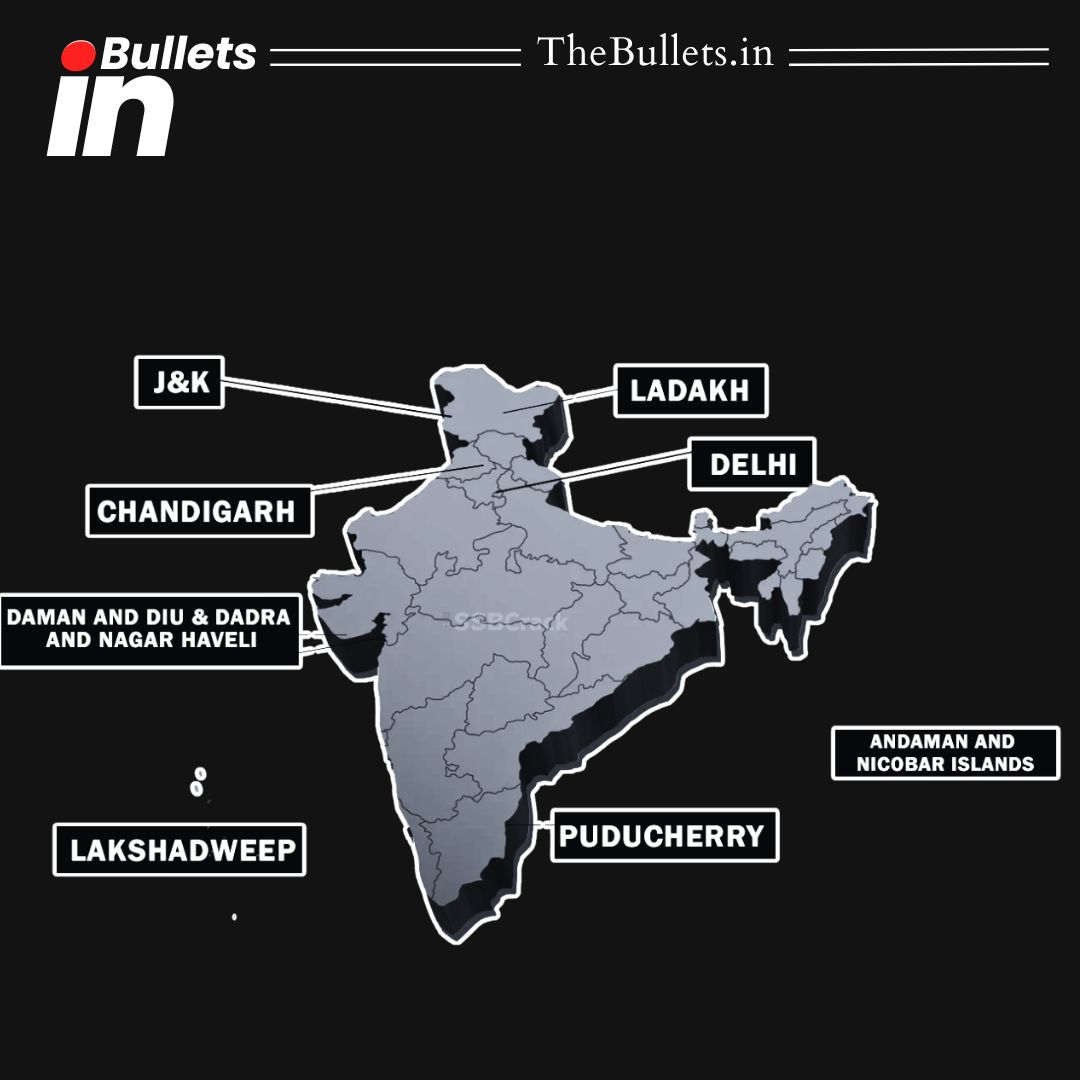


Union Territories (UTs) are centrally administered regions in India, designed for strategic, administrative, and cultural purposes, with varying governance models and constitutional provisions ensuring effective national integration.
BulletsIn
- Union Territories are governed under Articles 239 to 241 of the Indian Constitution, with the President exercising administrative control through appointed administrators or Lieutenant Governors.
- The concept originated during British rule in 1874 as Scheduled Districts, later becoming Chief Commissioner’s Provinces, and post-independence classified as Part C and Part D states.
- The States Reorganisation Act, 1956 and 7th Constitutional Amendment restructured territories, leading to creation of UTs and eventual statehood for regions like Himachal Pradesh and Manipur.
- UTs are created based on strategic importance, administrative efficiency, cultural uniqueness, and the need to protect backward or tribal populations across diverse regions.
- Some UTs like Delhi, Puducherry, and Jammu and Kashmir have legislative assemblies and elected governments, while others are directly governed without legislatures.
- Parliament holds overriding authority to legislate on all subjects for UTs, including those in the State List, ensuring centralized governance and uniform policy implementation.
- The President can issue regulations for certain UTs like Andaman and Nicobar Islands and Lakshadweep, which carry the same legal authority as parliamentary laws.
- Delhi has special constitutional status under Article 239AA, allowing limited legislative powers while key subjects like police, land, and public order remain under central control.
- The Ministry of Home Affairs acts as the nodal body managing UT affairs, supported by advisory bodies like the Home Ministers Advisory Committee and Administrative Advisory Committee.
- Recent changes include the 2019 reorganization of Jammu and Kashmir into two UTs and the 2020 merger of Dadra and Nagar Haveli with Daman and Diu into a single UT.



What do you think?
It is nice to know your opinion. Leave a comment.