











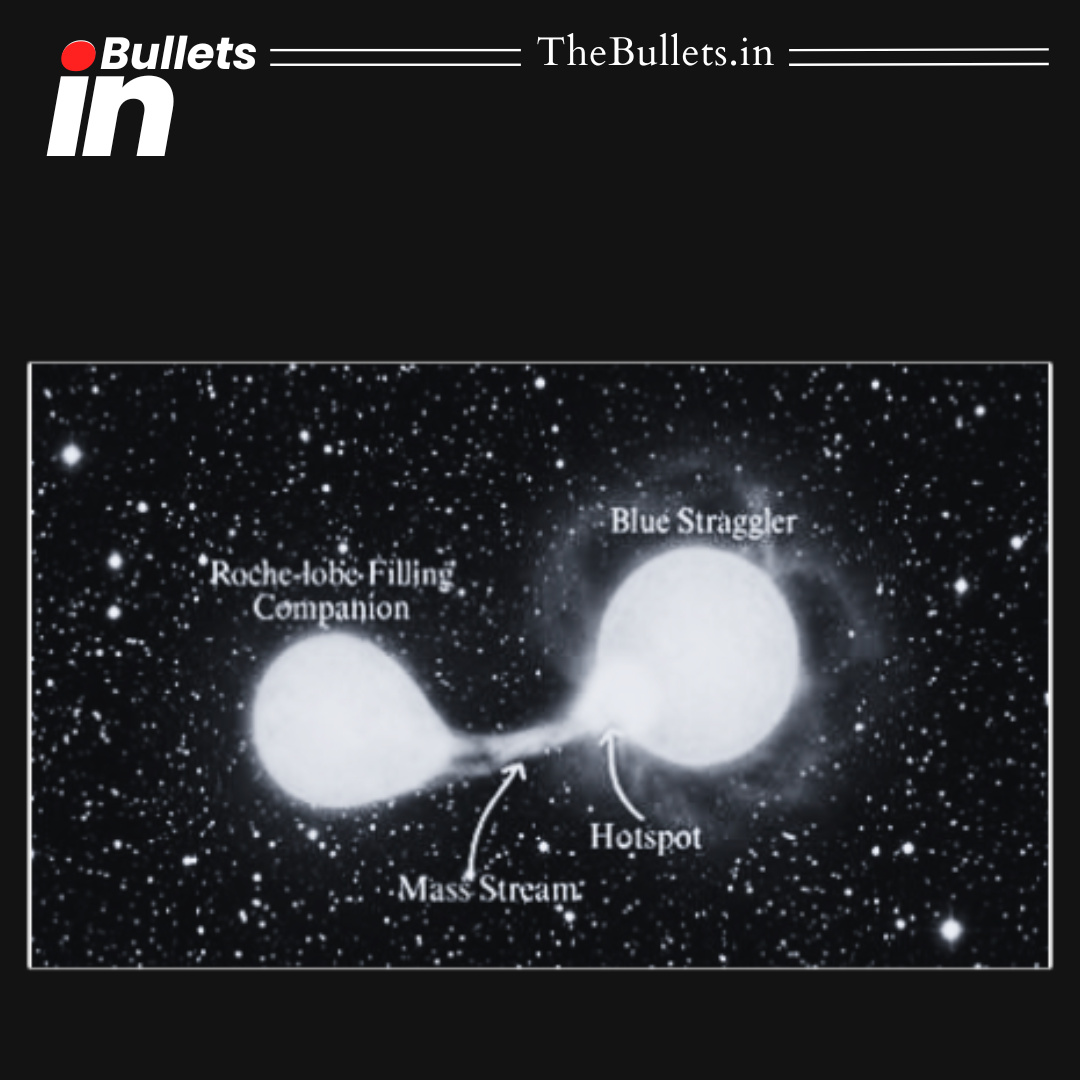


Indian astronomers, in collaboration with international researchers, have directly observed a Blue Straggler Star forming through mass transfer in a binary star system, providing the strongest observational evidence yet for one of astronomy’s longest-standing theories on stellar evolution.
BulletsIn
- A team of Indian and international astronomers, led by scientists from the Indian Institute of Astrophysics (IIA), has successfully captured a rare Blue Straggler Star (BSS) in the process of formation, marking a major breakthrough in stellar astronomy.
- The landmark study, published in The Astrophysical Journal Letters, provides direct observational evidence that Blue Straggler Stars are formed through mass transfer between binary stars, validating a theory proposed decades ago.
- Researchers investigated the binary star system TIC 327546480, located in the ancient open star cluster Collinder 261, approximately 9,500 light-years from Earth, using data from NASA’s Transiting Exoplanet Survey Satellite (TESS) and the European Southern Observatory’s Very Large Telescope in Chile.
- The study revealed that the binary system is semi-detached, allowing material from one star to flow across its Roche lobe onto its companion, causing the receiving star to gain mass, become hotter, brighter, and effectively rejuvenate into a Blue Straggler Star.
- Scientists also detected strong X-ray emissions, confirming that the mass-transfer process is actively occurring, making this one of the clearest real-time observations of Blue Straggler formation ever recorded.
- Detailed analysis showed that the newly forming Blue Straggler possesses a mass approximately 1.67 times that of the Sun, while its companion has about 0.32 solar masses. The two stars complete one orbit every 2.11 days.
- Evolutionary modelling indicates that the mass-transfer process began around 5.46 billion years ago and is still continuing today, while the host star cluster Collinder 261 is estimated to be nearly 7 billion years old.
- The research was led by Ali Hasan Sheikh, a doctoral researcher at Gauhati University and INSPIRE Fellow, with contributions from scientists representing the Indian Institute of Astrophysics, Gauhati University, IUCAA Pune, INAF Italy, LUX Observatoire de Paris, and the University of North Florida, advancing global understanding of stellar evolution and binary star systems.



What do you think?
It is nice to know your opinion. Leave a comment.