











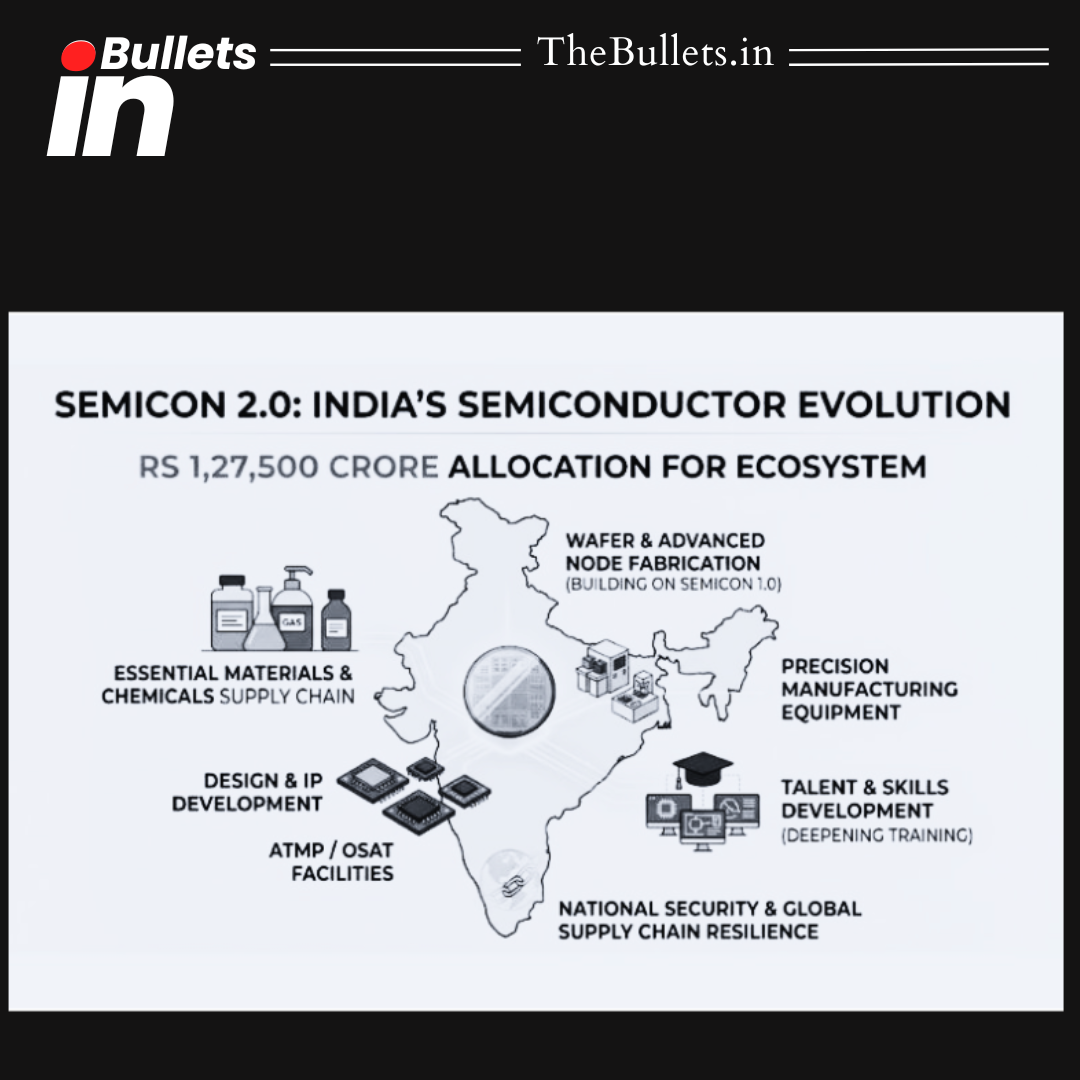


India is moving beyond individual chip facilities toward a comprehensive semiconductor ecosystem spanning design, manufacturing, packaging, equipment, materials, research and talent.
BulletsIn
- Semicon 2.0, approved in July 2026, carries an outlay of ₹1,27,500 crore to strengthen India’s semiconductor ecosystem and global supply-chain participation.
- Prime Minister Narendra Modi inaugurated SEMICON India 2026 in New Delhi, bringing industry leaders, investors, policymakers, academia and start-ups together.
- India’s semiconductor demand is projected to reach USD 110 billion by FY2030 and exceed USD 200 billion by FY2035.
- Semiconductor imports reached nearly USD 150 billion between FY2017 and FY2025, highlighting India’s dependence on global chip supply chains.
- Semicon 1.0, approved with ₹76,000 crore in 2021, established schemes supporting semiconductor fabs, display manufacturing, compound chips and packaging facilities.
- Twelve semiconductor manufacturing units have received approval, representing cumulative investment above ₹1.64 lakh crore across multiple Indian states.
- India’s chip-design ecosystem includes 24 approved projects, while more than one lakh engineers have accessed advanced design tools across 500 organisations.
- India hosts around 7 percent of global semiconductor-domain capability centres and employs nearly 20 percent of the worldwide semiconductor chip-design workforce.
- Semicon 2.0 expands India’s ambition across advanced packaging, equipment, materials, research and talent alongside chip design and manufacturing capabilities.
- Rising demand from artificial intelligence, 5G, electric mobility, autonomous vehicles and data centres is expected to accelerate India’s semiconductor opportunities.



What do you think?
It is nice to know your opinion. Leave a comment.