





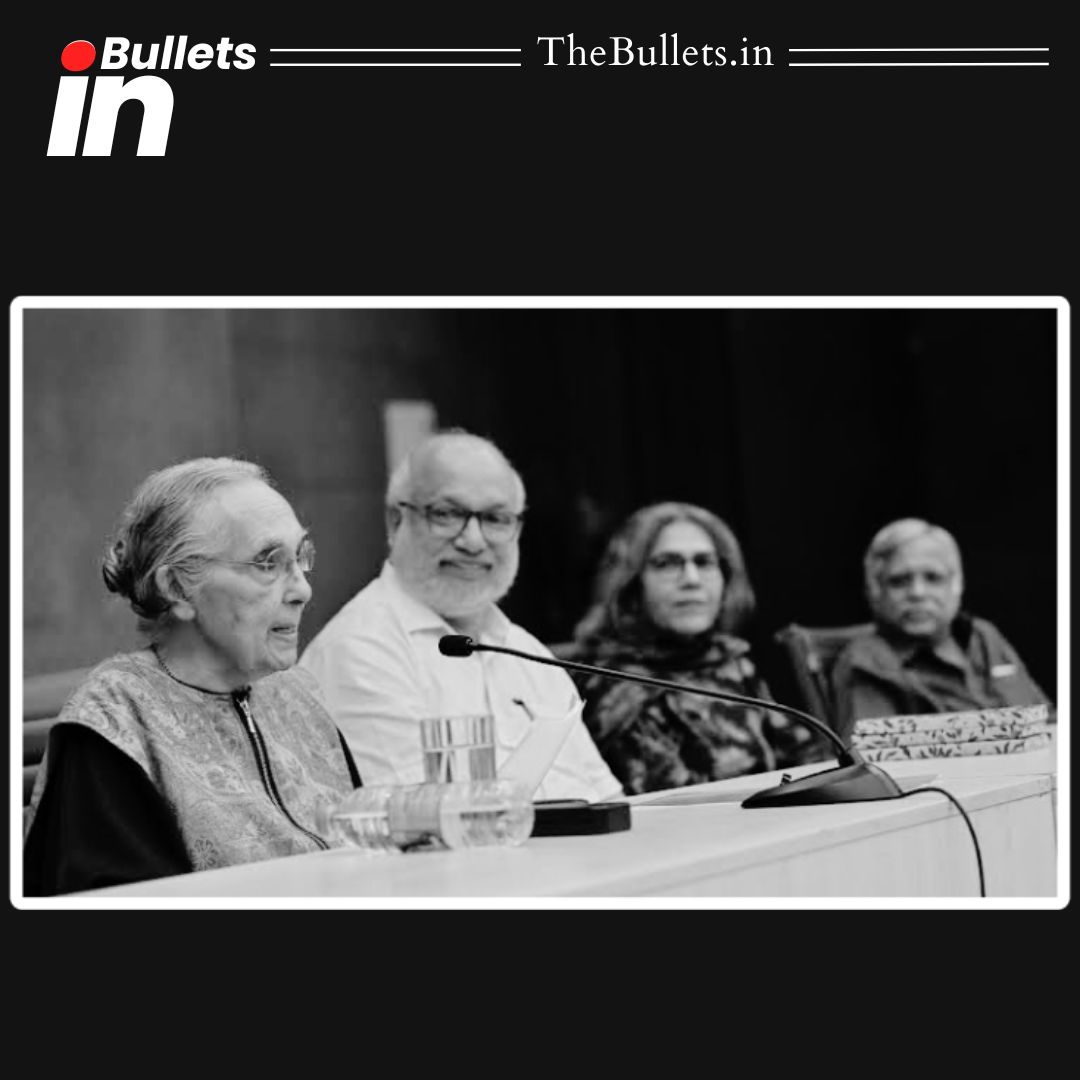


Historian Romila Thapar argued that colonial-era frameworks still shape how Indian history is read, and that a Hindutva interpretation repeats the same reductive habit.
BulletsIn
- Historian Romila Thapar delivered the Second Sitaram Yechury Memorial Lecture on "Historiography and Early Indian History".
- The 96-year-old historian said colonial scholars shaped how Indian history came to be understood, reducing complex processes to religious narratives.
- She noted that colonial writers viewed Asian societies through "oriental despotism", portraying them as static and ruled by despots.
- Thapar criticised James Mill's division of Indian history into Hindu, Muslim and British periods as an overly simple religious classification.
- She argued that reading Indian history mainly through a religious lens is a habit inherited from colonial scholarship.
- She described the Hindutva reading of history as single and fixed, overlooking the multiplicity within Hinduism itself.
- In her view, that reading uses history to construct contemporary political statements rather than to explain what actually happened.
- She said such an approach denies secularism and democracy their central place in the idea of the new nation.
- The lecture series honours the late CPI(M) general secretary Sitaram Yechury.
- The remarks add to continuing debate over how Indian history is written and taught.



What do you think?
It is nice to know your opinion. Leave a comment.