











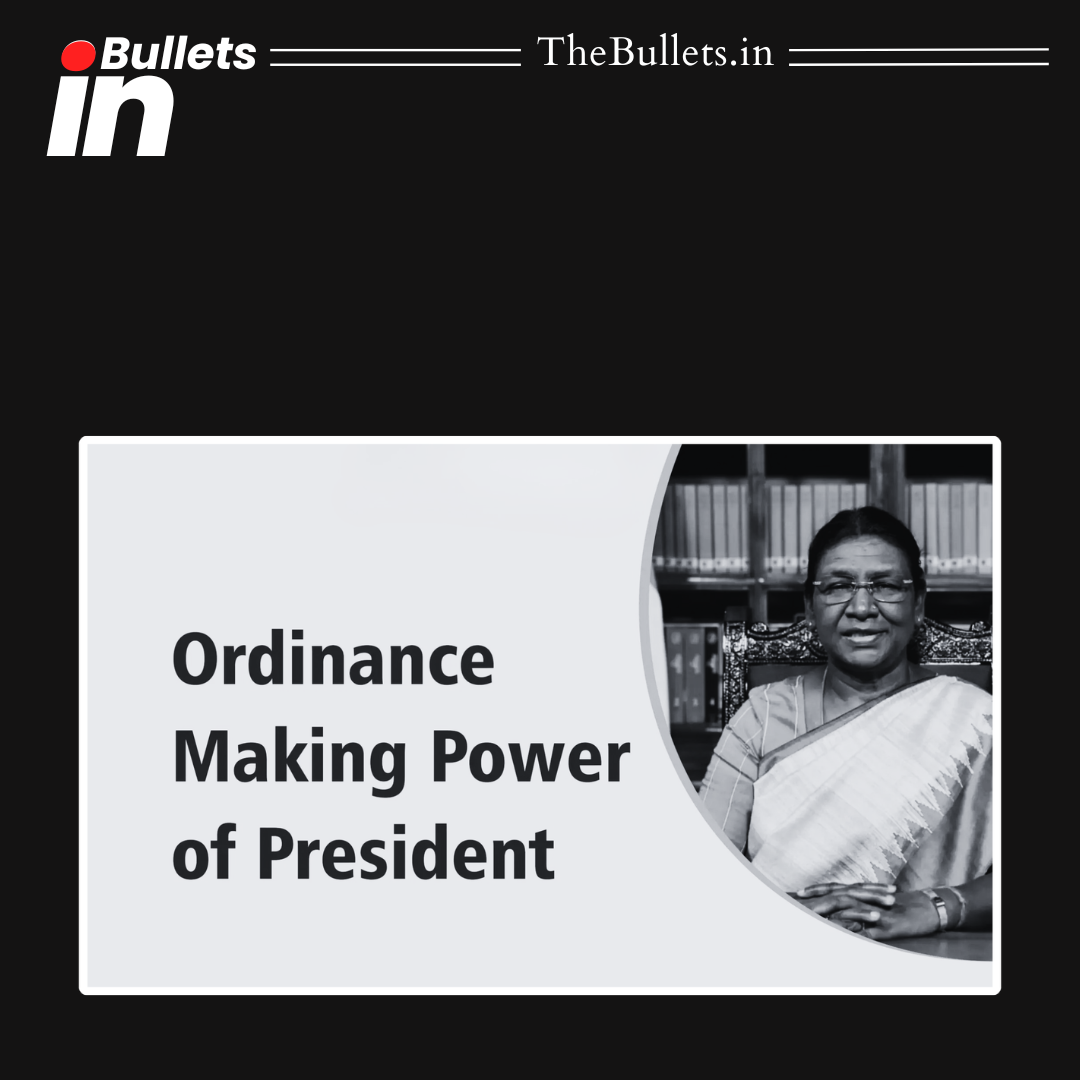


The ordinance-making power enables the President to enact temporary laws during Parliament’s absence, ensuring governance continuity while remaining subject to parliamentary approval and constitutional safeguards.
BulletsIn
- Article 123 of the Indian Constitution empowers the President of India to promulgate ordinances when Parliament is not in session
- Ordinances have the same force and effect as laws passed by Parliament
- They are temporary and must be approved once Parliament reconvenes
- The President exercises this power on the advice of the Council of Ministers (not discretionary)
- Ordinances must be laid before both Houses of Parliament of India
- They cease to operate if not approved within six weeks of reassembly
- The scope of ordinance-making is co-extensive with Parliament’s legislative powers
- Ordinances cannot amend the Constitution or violate Fundamental Rights
- They can be retrospective and may amend or repeal existing laws, including tax laws
- The President’s satisfaction is subject to judicial review
- Prevents misuse and ensures constitutional compliance
- D.C. Wadhwa case restricted repeated re-promulgation of ordinances
- Reinforces parliamentary supremacy and democratic accountability



What do you think?
It is nice to know your opinion. Leave a comment.