











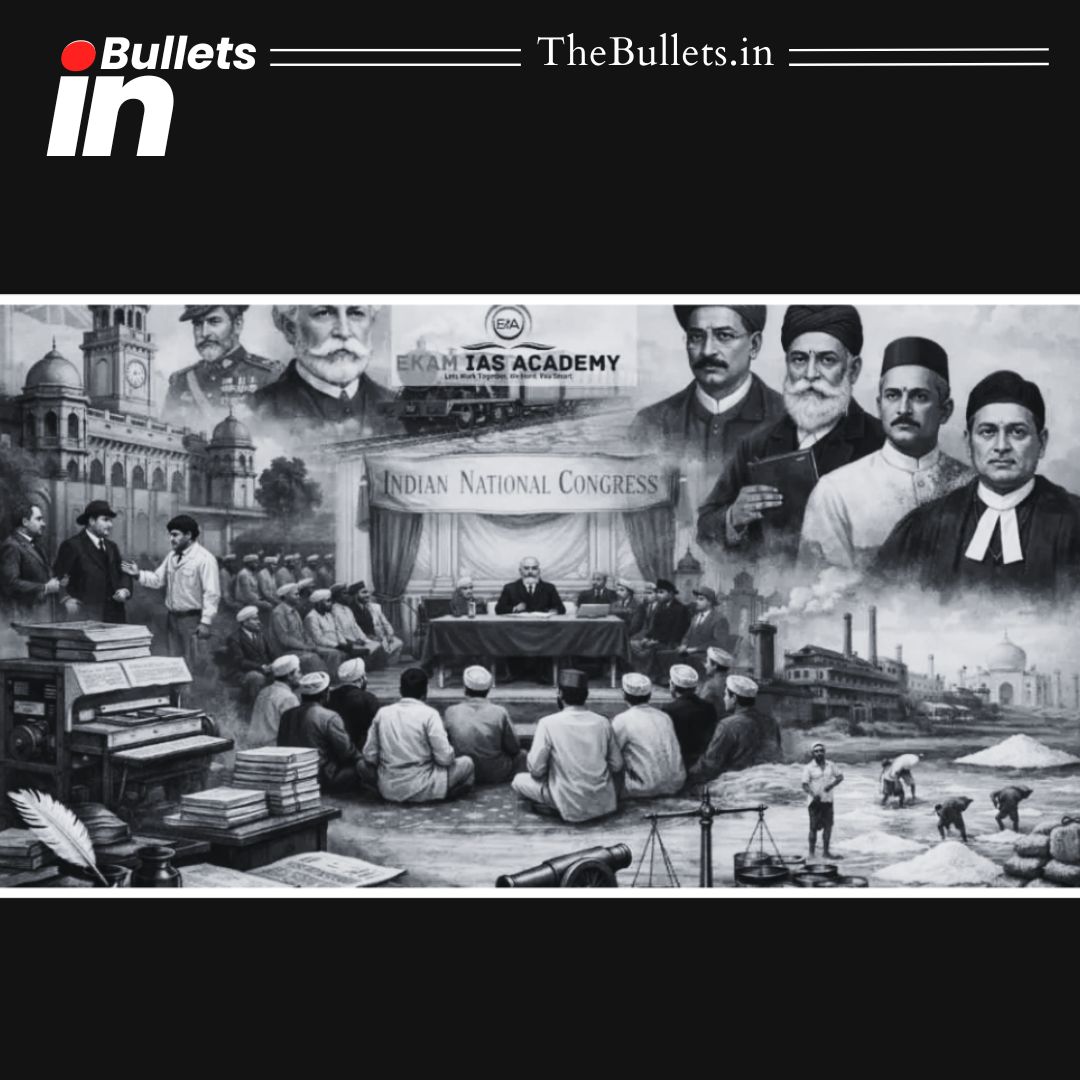


The Moderate Phase of Indian nationalism from 1885 to 1905 marked the beginning of organized political activity, focusing on constitutional reforms, economic critique, and national political awareness.
BulletsIn
- Early nationalism in India developed due to political unification under British rule, Western education, growth of the press, and reaction to discriminatory colonial policies.
- The Indian National Congress was founded in December 1885 at Gokuldas Tejpal Sanskrit College in Bombay with W.C. Bonnerjee as its first president.
- A.O. Hume played a key role in organizing the Congress, leading to the debate between the Safety Valve Theory and the Lightning Conductor Theory.
- Prominent Moderate leaders included Dadabhai Naoroji, Gopal Krishna Gokhale, Surendranath Banerjea, Pherozeshah Mehta and Justice M.G. Ranade.
- Moderates followed the constitutional approach known as the Three P’s method – Prayers, Petitions and Protests to demand reforms from the British government.
- Their political demands included expansion of legislative councils, simultaneous civil services examinations in India and England, and separation of the judiciary from the executive.
- The most important contribution of the Moderates was the economic critique of colonial rule, especially Dadabhai Naoroji’s Drain of Wealth Theory.
- Although their movement remained limited to the educated elite, Moderates laid the intellectual foundation for later mass nationalist movements.



What do you think?
It is nice to know your opinion. Leave a comment.