





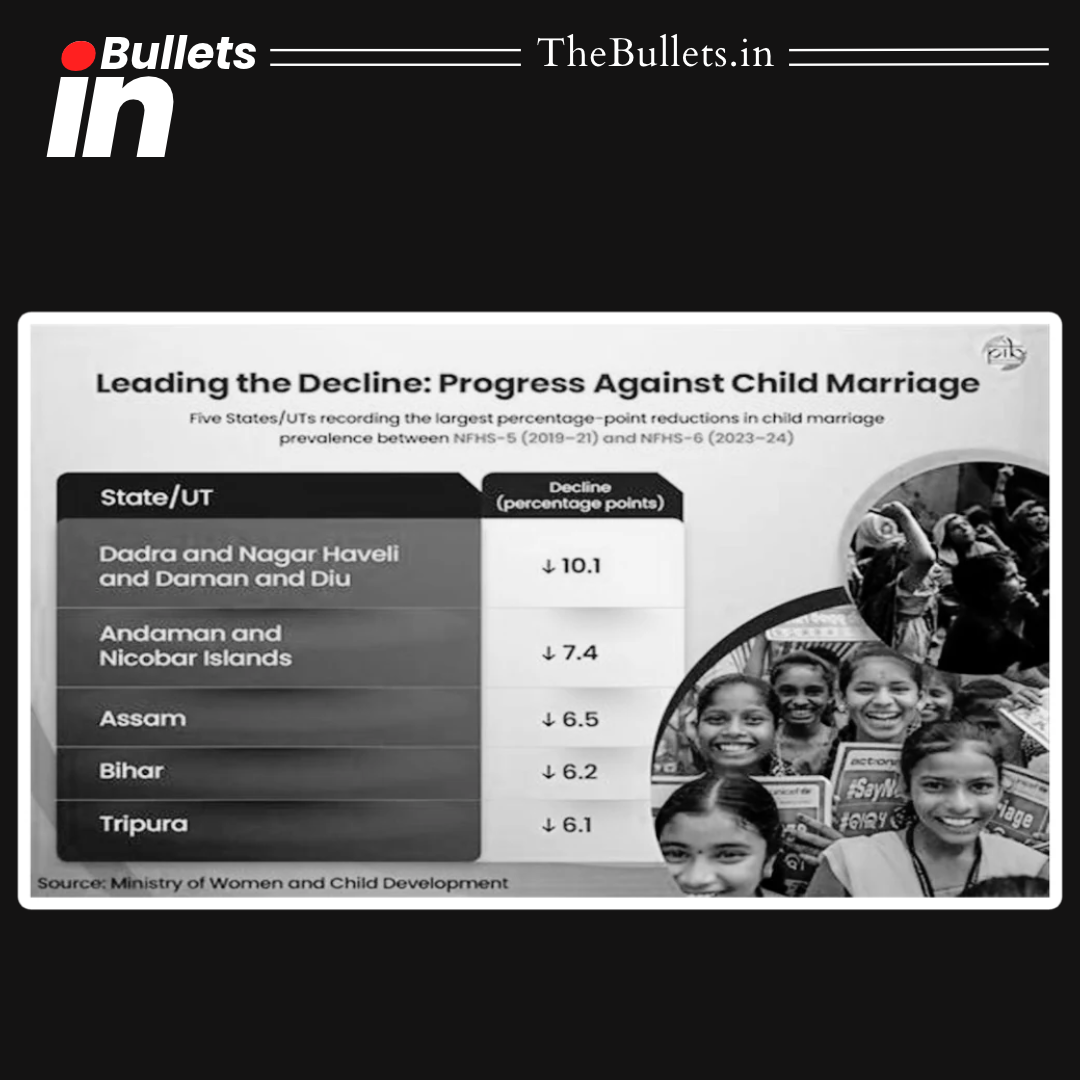


India’s Bal Vivah Mukt Bharat campaign has completed two years, strengthening legal enforcement, community awareness and girls’ empowerment to eliminate child marriage.
BulletsIn
- The Ministry of Women and Child Development launched Bal Vivah Mukt Bharat on November 27, 2024, targeting a child marriage-free India by 2030.
- According to NFHS-6, 20.1% of women aged 20–24 were married before 18, declining from 23.3% recorded in NFHS-5.
- The campaign has organised 6.85 lakh awareness programmes, reached 12.47 crore participants and collected 42.01 lakh pledges nationwide.
- Child marriage exposes girls to early pregnancy risks, domestic violence, interrupted education, restricted economic opportunities and persistent gender inequality.
- The Prohibition of Child Marriage Act, 2006, replaced the Child Marriage Restraint Act, 1929, establishing stronger legal safeguards against child marriage.
- Under the Act, males below 21 years and females below 18 years are considered children, and marriages involving either fall within its definition.
- Child marriages are generally voidable at the option of the affected party, who can approach the District Court within the prescribed period.
- The Act provides penalties including imprisonment up to two years and fines up to ₹1 lakh for specified offenders, subject to statutory provisions.
- District Magistrates and Child Marriage Prohibition Officers are responsible for preventive action, awareness programmes, evidence collection and reporting suspected child marriages.
- Judicial Magistrates can issue injunctions to prevent impending child marriages, while authorities focus on early intervention during festivals and mass marriage occasions.



What do you think?
It is nice to know your opinion. Leave a comment.