











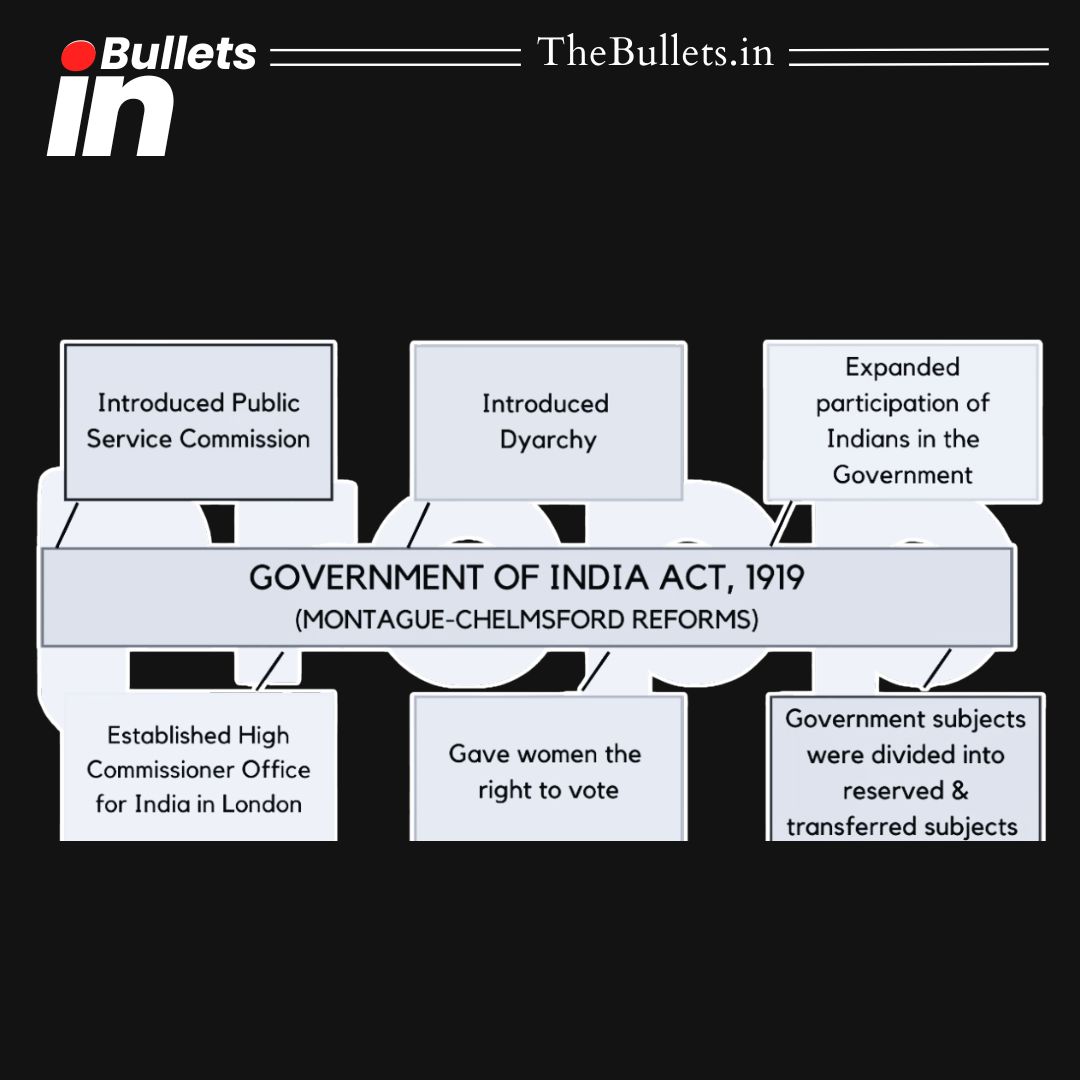


The Government of India Act 1919, based on the Montagu-Chelmsford Reforms, marked a major constitutional development by introducing limited self-governance and increasing Indian participation in administration.
BulletsIn
- The Government of India Act 1919, also known as the Montagu-Chelmsford Reforms, was based on recommendations by Edwin Montagu and Lord Chelmsford.
- It introduced the concept of dyarchy in provinces, dividing subjects into reserved and transferred categories, with partial responsibility given to Indian ministers.
- Administrative subjects were divided into central and provincial lists through Devolution Rules, enabling limited decentralisation of power from the centre to provinces.
- For the first time, a bicameral legislature was introduced at the centre, consisting of the Council of State (Upper House) and Legislative Assembly (Lower House).
- The Act increased Indian representation in governance, with three Indians included in the Viceroy’s Executive Council, though real power remained with British authorities.
- It expanded the system of separate electorates to include Sikhs, Indian Christians, Anglo-Indians, and Europeans, reinforcing communal representation in politics.
- The Act provided limited franchise based on property, tax, and education, restricting voting rights to a small section of the population.
- It laid the foundation for future constitutional reforms by proposing a statutory commission, which later led to the Simon Commission and eventually the Government of India Act 1935.



What do you think?
It is nice to know your opinion. Leave a comment.