











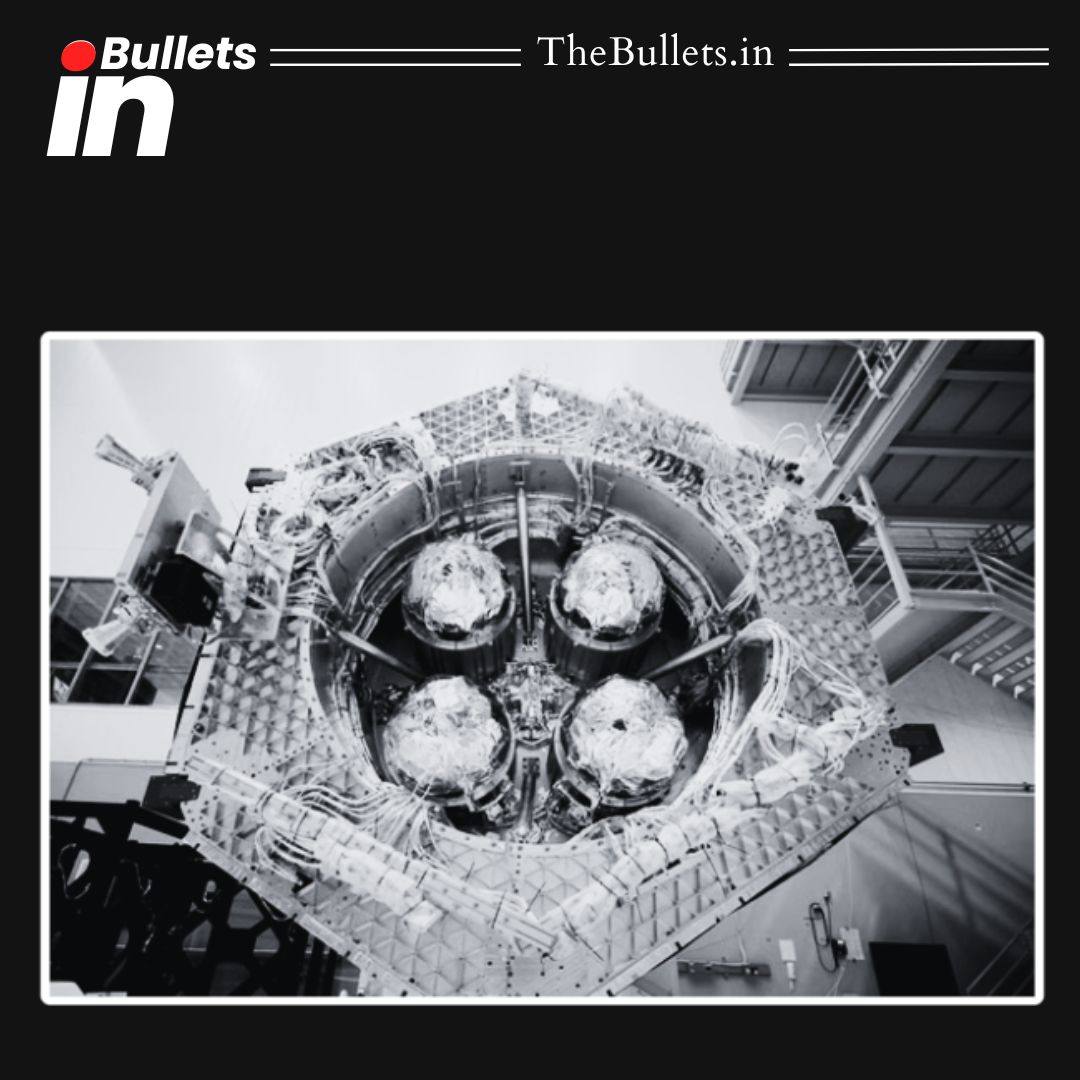


NASA has completed the final assembly of the Nancy Grace Roman Space Telescope, marking a major milestone toward its planned 2026 launch and advancing next-generation space observation capabilities.
BulletsIn
- The Nancy Grace Roman Space Telescope has been assembled at Goddard Space Flight Center, representing a significant step in NASA’s preparation for its upcoming space observatory mission.
- Designed as a successor to Hubble Space Telescope and James Webb Space Telescope, the telescope will explore dark energy, galaxy formation, and distant planetary systems with advanced precision.
- The observatory features a 2.4-metre primary mirror similar to Hubble, but its field of view is nearly 100 times larger, enabling faster and broader cosmic surveys.
- NASA states the telescope can gather survey data nearly 1,000 times faster than Hubble, making it highly efficient for mapping vast regions of the universe in detail.
- A key objective is studying Dark Energy and Dark Matter, which together constitute most of the universe and influence cosmic expansion and galaxy motion.
- The telescope will generate large three-dimensional maps of galaxies, helping scientists understand how cosmic structures evolved and refine models of the universe’s expansion.
- Roman will repeatedly scan the same sky regions, allowing detection of transient cosmic events like Supernova explosions that may otherwise remain undetected.
- NASA expects the mission to identify thousands of supernovae, providing critical data to study cosmic expansion and improve understanding of the universe’s long-term evolution.



What do you think?
It is nice to know your opinion. Leave a comment.