











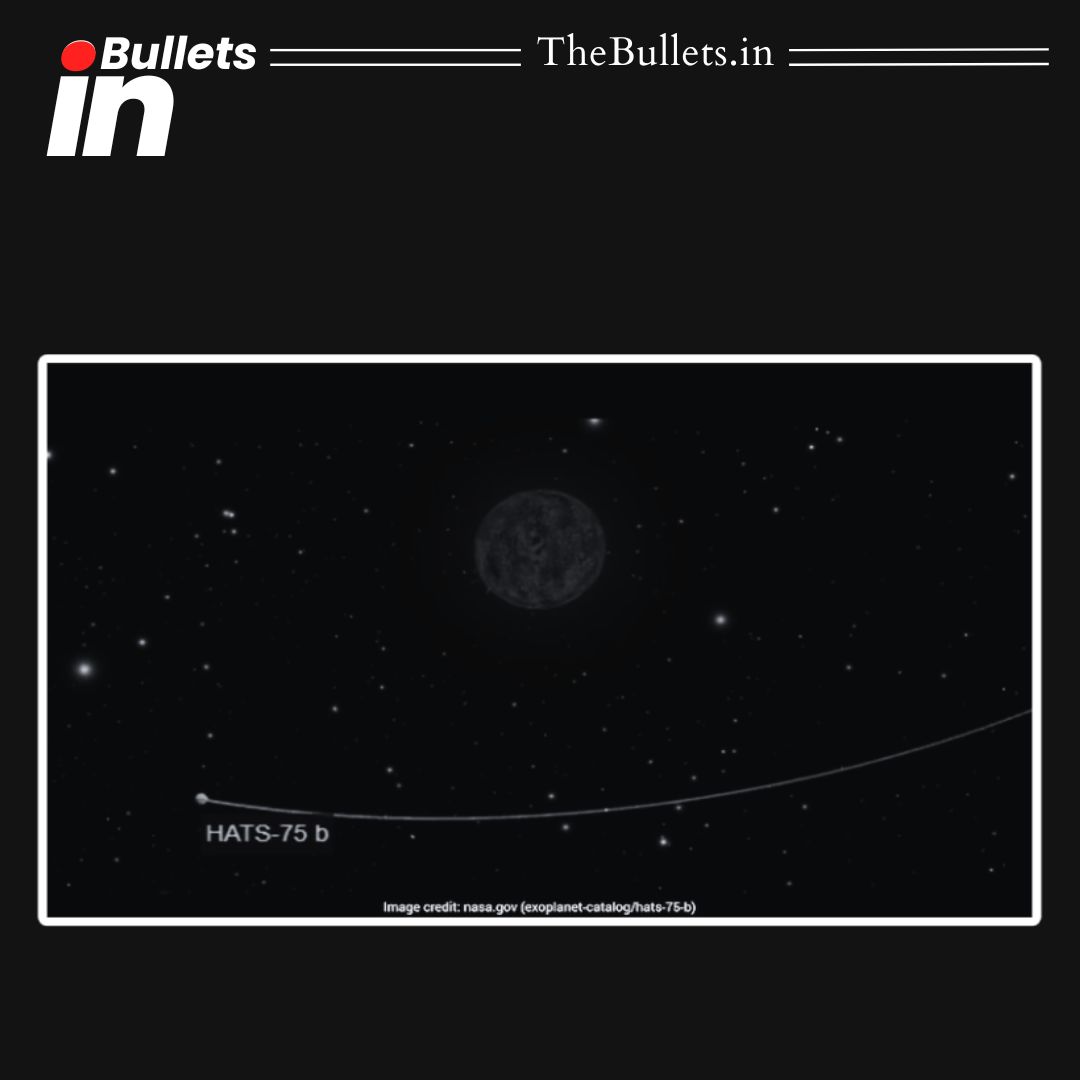


Astronomers using the James Webb Space Telescope have uncovered new insights into exoplanet HATS-75 b, including atmospheric composition and challenges caused by its host star.
BulletsIn
- Scientists observed HATS-75 b, a giant planet located about 637 light-years away, orbiting a low-mass M-dwarf star using advanced JWST instruments.
- The study focused on analysing the planet’s atmosphere by tracking its transit across the host star, allowing researchers to examine how starlight interacts with atmospheric gases.
- Researchers detected strong chemical signatures of methane along with carbon dioxide and carbon monoxide, offering key insights into the planet’s atmospheric composition.
- Water presence remains uncertain as stellar interference likely masks its signal, making it difficult for scientists to confirm water vapor despite expectations.
- The host star shows starspots and bright regions that distort observational data, creating what scientists call the Transit Light Source effect during planetary transits.
- Initial observations suggested a hazy atmosphere, but further analysis revealed that stellar contamination, rather than haze, was influencing the spectral data.
- The planet has a low-metallicity atmosphere dominated by hydrogen and helium, along with an unusually high carbon-to-oxygen ratio compared to typical gas giants.
- The findings highlight how stellar activity can complicate exoplanet studies, emphasizing the need for precise corrections when interpreting atmospheric data from distant worlds.



What do you think?
It is nice to know your opinion. Leave a comment.